Tokenmaxxing: Why More AI Tokens Do Not Always Mean Better Results
By Dan Gatti–As enterprises race to deploy Generative AI and Agentic AI solutions, a new term has emerged across the technology industry: Tokenmaxxing.
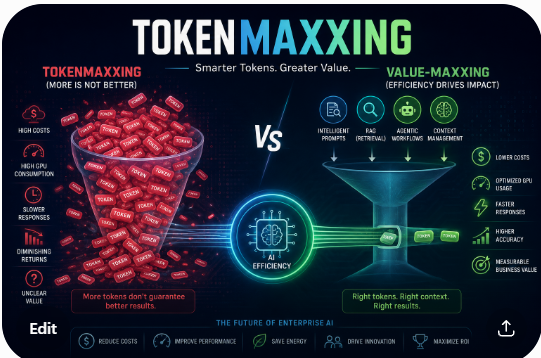
Tokenmaxxing refers to the practice of maximizing AI token consumption, often without regard to efficiency, business value, or return on investment. In the early stages of enterprise AI adoption, organizations encouraged employees to use AI as much as possible. Success was frequently measured by the number of prompts submitted, tokens consumed, or hours spent interacting with AI systems.
Today, that mindset is changing.
Understanding Tokens
Tokens are the fundamental units of information processed by Large Language Models (LLMs). Every prompt, document upload, conversation, code review, or AI-generated response consumes tokens. As AI usage scales across organizations, token consumption directly impacts infrastructure requirements, cloud costs, and operational budgets.
Industry reports show that some enterprises are now processing trillions of tokens each month, creating substantial financial and infrastructure demands. As a result, executives are beginning to ask a more important question:
Are we maximizing business outcomes or simply maximizing token consumption?
The Hidden Cost of Tokenmaxxing
Many organizations initially viewed AI usage as a positive metric. More prompts meant greater adoption. More tokens suggested higher engagement.
However, research and real-world deployments are revealing several challenges:
- Increased infrastructure and cloud costs
- Higher GPU consumption and energy requirements
- Longer response times
- Diminishing returns from excessively large prompts
- Difficulty measuring true business value
Studies have shown that larger context windows and higher token usage do not automatically improve performance. In many cases, excessive information can actually reduce reasoning quality and create unnecessary processing overhead.
Why Efficient AI Wins
The most successful AI deployments focus on efficiency rather than volume.
Leading organizations are implementing:
Intelligent Prompt Engineering
Providing only the information required to complete a task rather than overwhelming models with unnecessary context.
Retrieval-Augmented Generation (RAG)
Instead of loading entire document repositories into a prompt, RAG retrieves only the most relevant information at runtime.
Agentic AI Workflows
AI agents can break complex tasks into smaller, targeted activities, reducing token consumption while improving accuracy.
Context Management
Modern AI architectures increasingly combine long-context models with memory systems, retrieval layers, and knowledge graphs to provide the right information at the right time.
The future of enterprise AI is not about feeding everything into the model. It is about delivering the most relevant information efficiently.
The Rise of AI Efficiency Metrics
Forward-thinking organizations are beginning to measure:
- Cost per successful outcome
- Revenue generated per AI workflow
- Productivity gains per token consumed
- Energy efficiency per inference
- Time saved per business process
This shift mirrors the evolution of cloud computing. Early cloud adopters focused on acquiring more compute resources. Mature organizations learned to optimize workloads and maximize business value.
AI is following the same path.
Looking Ahead
The next phase of enterprise AI will be defined by optimization rather than expansion. While context windows continue to grow from hundreds of thousands to millions of tokens, the most successful organizations will not be those that consume the most tokens. They will be the organizations that extract the greatest value from every token used.
In the age of Agentic AI, the goal is no longer tokenmaxxing.
The goal is value-maxxing—delivering measurable business outcomes with intelligent, efficient, and scalable AI systems.
Organizations that embrace this philosophy will reduce costs, improve performance, and accelerate AI-driven innovation while maintaining a competitive advantage in an increasingly AI-powered economy.
Category: Uncategorized


