How Agentic AI Will Transform the Supermarket Supply Chain
By Big Data AI & IoT Forum—The supermarket industry operates on razor-thin margins, massive inventory complexity, and constant pressure to meet consumer expectations. Every day, retailers must balance product availability, spoilage reduction, labor efficiency, transportation logistics, and rapidly changing customer demand.
Traditional automation and analytics systems have improved visibility—but they still depend heavily on human coordination and reactive decision-making.
That is beginning to change with the emergence of Agentic AI.
What Is Agentic AI?
Agentic AI refers to intelligent AI systems capable of:
- Planning
- Reasoning
- Coordinating across systems
- Taking autonomous actions
- Continuously adapting based on outcomes
Unlike traditional AI tools that simply provide recommendations, agentic AI systems can execute multi-step workflows across enterprise systems with minimal human intervention.
For supermarkets, this creates the opportunity for a more autonomous, responsive, and intelligent supply chain.
The Supermarket Supply Chain Problem
Modern grocery operations face enormous complexity:
- Thousands of SKUs across multiple stores
- Perishable inventory with limited shelf life
- Weather-driven demand fluctuations
- Labor shortages
- Transportation disruptions
- Supplier inconsistency
- Real-time pricing pressures
Even minor forecasting errors can result in:
- Empty shelves
- Excess waste
- Margin erosion
- Lost customer loyalty
The challenge is no longer access to data—it is the ability to act on data fast enough.
How Agentic AI Changes the Model
Agentic AI introduces autonomous orchestration across the supply chain.
Instead of disconnected systems operating independently, AI agents coordinate decisions across procurement, warehousing, logistics, inventory management, and store operations.
Key Applications of Agentic AI in Supermarkets
1. Predictive Inventory Optimization
AI agents continuously analyze:
- POS sales data
- Weather patterns
- Local events
- Seasonal buying trends
- Social sentiment
- Supplier lead times
The system dynamically adjusts replenishment levels before shortages occur.
Example:
If a heatwave is forecast in Southern California, AI agents may automatically increase orders for:
- Bottled water
- Ice
- Produce
- BBQ products
- Beverages
before human planners even recognize the trend.
2. Autonomous Replenishment
Traditional replenishment often relies on static reorder thresholds.
Agentic AI enables:
- Dynamic reorder decisions
- Real-time supplier coordination
- Automated purchase order generation
- Exception-based human escalation
The AI system becomes an operational coordinator—not just an analytics dashboard.
3. Spoilage and Waste Reduction
Perishable inventory is one of the largest margin risks in grocery retail.
Agentic AI can:
- Predict spoilage windows
- Dynamically adjust pricing
- Coordinate redistribution between stores
- Recommend promotional discounts automatically
This helps supermarkets reduce food waste while protecting profitability.
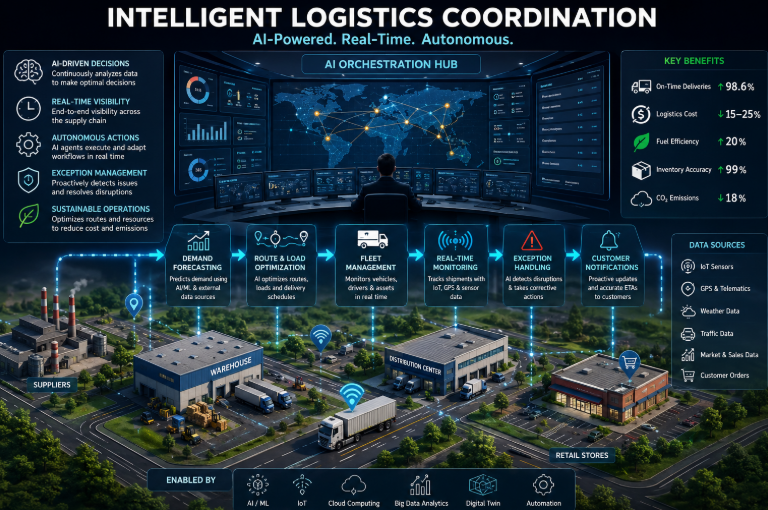
4. Intelligent Logistics Coordination
AI agents can optimize:
- Delivery routing
- Warehouse loading schedules
- Fuel efficiency
- Fleet utilization
- Cold-chain monitoring
When disruptions occur—traffic, weather, equipment failures—the system autonomously reroutes shipments and updates store-level expectations in real time.
5. Workforce Optimization
Labor is one of the largest operational costs for supermarkets.
Agentic AI systems can coordinate staffing based on:
- Predicted customer traffic
- Delivery schedules
- Shelf replenishment demand
- Online order volumes
This improves labor utilization while enhancing customer service.
6. Hyper-Personalized Consumer Engagement
When connected to loyalty platforms and IoT-enabled retail systems, agentic AI can create personalized shopping experiences by:
- Predicting customer preferences
- Delivering targeted promotions
- Dynamically adjusting digital pricing
- Optimizing product placement
This transforms the supermarket from reactive retail into an intelligent commerce platform.
The Role of IoT in Agentic AI Supply Chains
Agentic AI becomes exponentially more powerful when combined with IoT infrastructure.
Connected systems provide real-time operational awareness through:
- Smart shelves
- RFID inventory tracking
- Refrigeration sensors
- Autonomous warehouse robotics
- Delivery vehicle telemetry
- Computer vision systems
IoT provides the sensory layer.
Agentic AI provides the decision-making layer.
Together, they create a self-optimizing retail ecosystem.
The Business Impact
Supermarkets implementing agentic AI architectures can potentially achieve:
- Lower spoilage rates
- Improved inventory turns
- Reduced stockouts
- Lower logistics costs
- Better labor efficiency
- Faster response to disruptions
- Improved customer satisfaction
Most importantly, agentic AI enables retailers to shift from reactive operations to predictive and autonomous operations.
Strategic Outlook
The supermarket industry is entering a new operational era.
Over the next five years, competitive differentiation will increasingly depend on:
- Real-time operational intelligence
- Autonomous workflow execution
- AI-driven supply chain coordination
- Integration of IoT and AI systems
Retailers that continue relying on fragmented systems and manual coordination may struggle to compete against AI-driven operational models.
The future supermarket supply chain will not simply be automated.
It will be intelligent, adaptive, and increasingly autonomous.
Category: Uncategorized


